Technology-informed. Surgeon-led.
Delivering Effective Robotic Joint Replacement in Houston
What Mako is, in plain terms
This review site offers this guide to help you discuss orthopedic robotic technology.
Mako is a robotic-arm-assisted system made by Stryker for hip and knee replacement. Dr. Cahill’s practice website describes using Mako for hip and knee replacement, including 3D planning before surgery. Practice website (opens external site in a new tab)
Planning before surgery
According to Stryker, the process typically starts with a CT scan of the joint. That scan is used to build a 3D model of the patient’s own anatomy, which the surgeon uses to plan implant size and position before the operation. Manufacturer overview (opens external site in a new tab)
A personalized plan is not the same as a custom-made implant. Planning around your anatomy does not mean an implant is manufactured just for you. Ask which implant and size are planned for your operation.
During surgery
Stryker describes the robotic arm as giving tactile feedback, sometimes called haptic boundaries. These virtual limits are set by the plan and are meant to help keep bone preparation within the planned area while the surgeon guides the instrument. Manufacturer overview (opens external site in a new tab)
The robotic tool is separate from the surgical approach, meaning the route the surgeon uses to reach the joint. Using a robot does not by itself determine the incision or approach.
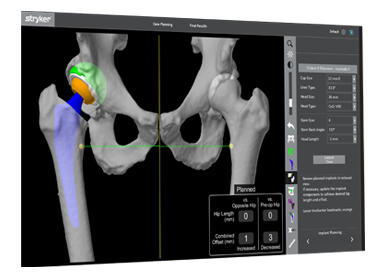
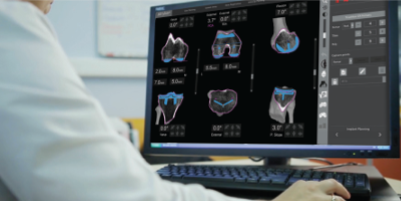
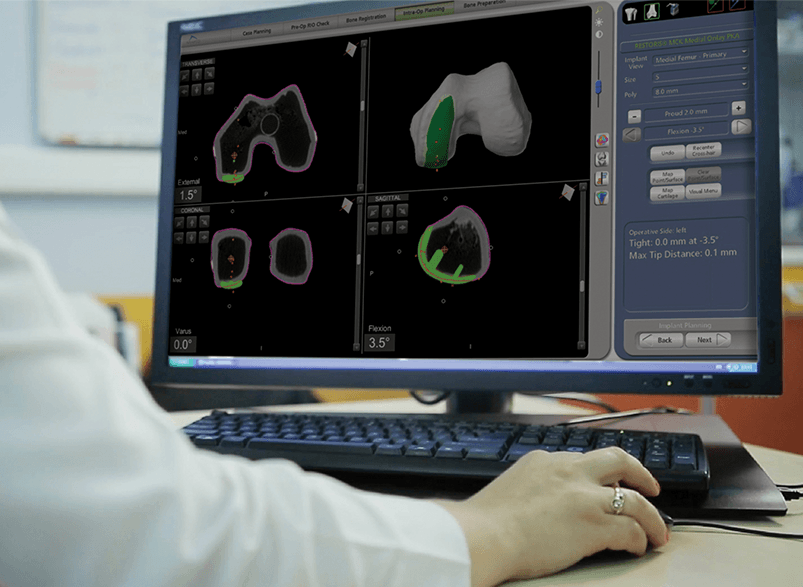
The planning images below are manufacturer examples from Stryker, not photographs of Dr. Cahill’s patients or confirmation of her equipment configuration.
Mako Total Hip
Planning tailored to your hip.
Workflow
- Step 1: Model the hip
- Step 2: Plan implant position
- Step 3: Guide socket preparation
A CT-based three-dimensional model helps the surgeon plan implant size and position. Robotic-arm guidance supports hip-socket preparation and cup placement.
Information about hip length and offset helps inform surgeon decisions. Offset means the side-to-side spacing of the hip.
Mako Total & Partial Knee
Planning matched to the procedure.
Workflow
- Step 1: Map the knee
- Step 2: Refine the plan
- Step 3: Guide preparation
CT-based planning plus information gathered during surgery supports implant positioning and surgeon-guided bone preparation.
Total knee
The surgeon evaluates component position and soft-tissue balance (how evenly the ligaments are tensioned), and can adjust the plan before bone preparation.
Partial knee
For appropriate patients, the plan focuses on the affected compartment or compartments—the worn areas of the knee. Robotic-arm guidance supports targeted bone preparation and implant positioning.
Surgeon judgment comes first
Dr. Cahill uses Mako as a tool for accuracy and efficiency, but her practice is not dependent on the robot. Not every procedure uses robotics, and the choice depends on the patient and the operation.
“Efficiency” here refers to planning and workflow: having a clear plan before the operation begins. It is not a promise of a shorter operation or a faster recovery.
Following a plan precisely does not guarantee a particular recovery, pain level or implant lifespan. Those depend on many factors, including health, bone quality, activity and rehabilitation.
Practical questions to ask at your visit
- Am I a good candidate for robotic-assisted surgery, or would a conventional approach suit me better?
- Will I need a CT scan beforehand, and how does insurance handle it?
- What surgical approach do you plan to use, and why?
- Which implants are you considering for me?
- What are the alternatives, including nonsurgical options?
- What does recovery usually look like for someone in my situation?
Next step: talk with the practice
Discuss whether Mako fits your treatment plan with the practice, or read more about Dr. Cahill. This site does not book appointments.
Sources
- Practice: Robotic hip and knee replacement (catherinecahillmd.com) (opens external site in a new tab)
- Practice: Dr. Cahill’s knee replacement information, including Mako Total and Partial Knee (opens external site in a new tab)
- Manufacturer: Stryker Mako overview (opens external site in a new tab)
- Manufacturer: Stryker Mako total knee (opens external site in a new tab)
- Manufacturer: Stryker Mako total hip (opens external site in a new tab)
- Manufacturer: Stryker Mako partial knee (opens external site in a new tab)
Explanations above are written in plain English and summarize these sources.